
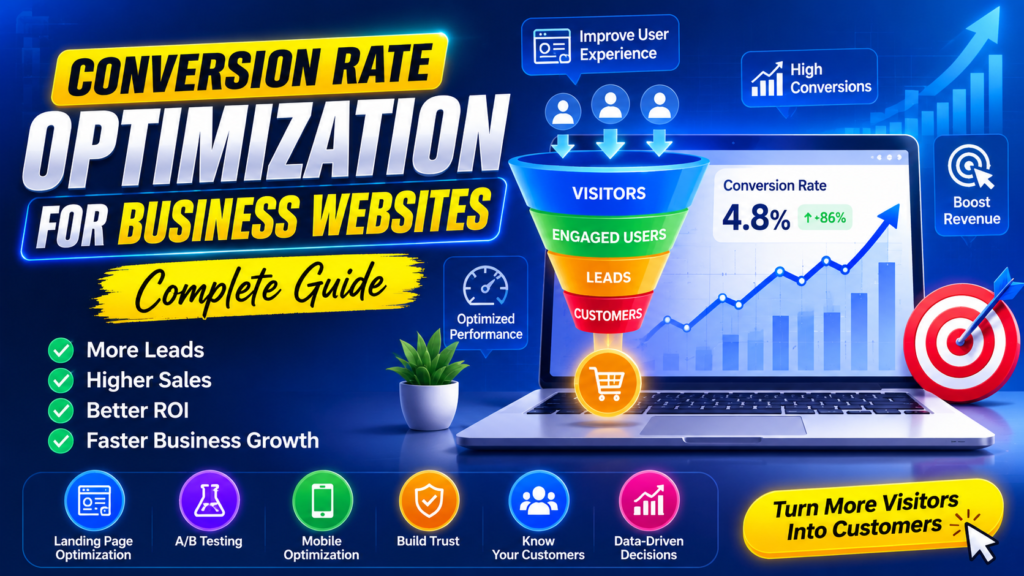
Conversion Rate Optimization for Business Websites: Complete Guide
This is where conversion rate optimization for business websites becomes important. Conversion Rate Optimization (CRO) is the systematic process of improving a website so that more visitors complete a valuable action, such as purchasing a product, submitting a contact form, requesting a quote, booking a consultation, signing up for a free trial, or subscribing to an email list.
A successful CRO strategy combines website analytics, user behavior, customer research, UX improvements, persuasive copywriting, landing page optimization, calls to action, and controlled experimentation. Instead of guessing what visitors want, businesses can use evidence to identify friction and test improvements.
This complete guide explains conversion rate optimization for business websites, why it matters, how to calculate conversion rates, the most important CRO strategies, common mistakes, useful metrics, and a step-by-step process businesses can use to improve website performance.
What Is Conversion Rate Optimization for Business Websites?
Conversion rate optimization for business websites means improving a website so a greater percentage of relevant visitors complete the actions that matter to the business.
A conversion does not always mean a purchase. For different businesses, a conversion can mean:
- Completing an online purchase
- Filling out a contact form
- Requesting a quote
- Booking an appointment
- Calling a business
- Registering for an account
- Starting a free trial
- Downloading a resource
- Subscribing to an email newsletter
- Requesting a product demonstration
For example, a consulting company may consider a consultation request a primary conversion, while an ecommerce store may focus on completed purchases.
Google Analytics allows businesses to identify important actions as key events, while conversion tracking can connect important actions with advertising and marketing measurement.
Why Is Conversion Rate Optimization for Business Websites Important?
Conversion rate optimization for business websites is important because increasing traffic is not always the most efficient way to increase business results.
Imagine a website receives 20,000 visitors per month and converts 2% of them. That produces 400 conversions.
If the conversion rate increases to 2.5% while traffic remains the same, the website would produce 500 conversions. That means the business could potentially generate 100 additional conversions without needing to acquire another 5,000 visitors.
This does not mean every website will achieve a particular improvement. CRO results depend on traffic quality, industry, customer intent, offer strength, website usability, testing quality, and many other factors. The bigger principle is that businesses should optimize both sides of digital marketing:
Traffic acquisition + conversion optimization = stronger marketing performance
A business that spends money attracting visitors should also make sure the website gives those visitors a clear and convenient path toward conversion.
How to Calculate Conversion Rate for Business Websites?
Understanding your current conversion rate is an essential first step in conversion rate optimization for business websites.
A basic conversion-rate formula is:
Conversion Rate = (Number of Conversions ÷ Number of Visitors or Relevant Interactions) × 100
For example, if 5,000 visitors generate 150 leads:
150 ÷ 5,000 × 100 = 3% conversion rate
However, businesses need to use the correct denominator for the metric they are analyzing. Google Ads, for example, defines conversion rate based on conversions divided by eligible ad interactions.
This distinction matters because different conversion goals may require different measurement approaches.
An ecommerce company could measure purchases per website session, while a B2B company may measure qualified form submissions per landing-page visitor.
Macro and Micro Conversions:
Businesses should also distinguish between macro and micro conversions.
Macro conversions are actions directly connected to major business outcomes, such as:
- Purchases
- Qualified leads
- Paid subscriptions
- Bookings
Micro conversions are smaller actions that indicate engagement, such as:
- Product-page views
- Add-to-cart actions
- Email signups
- Video views
- Pricing-page visits
Tracking both helps businesses understand where visitors are progressing or dropping out of the customer journey.
Conversion Rate Optimization for Business Websites: Identify Conversion Goals
Before changing your website, clearly define what you want visitors to do.
This is one of the most important steps in conversion rate optimization for business websites because optimization without a defined goal can become confusing.
For example:
- Ecommerce: Complete a purchase
- SaaS: Start a free trial
- B2B: Request a demo
- Local business: Book an appointment
- Consulting business: Request a consultation
- Content website: Subscribe to a newsletter
Once the primary conversion is defined, supporting metrics can be established.
A website may have several conversion actions, but each should have a clear purpose and measurement method.

Conversion Rate Optimization for Business Websites: Analyze Your Data
Data analysis should come before major website changes.
Start by examining:
- Website traffic
- Conversion rates
- Traffic sources
- Landing pages
- Exit pages
- Device performance
- Browser performance
- Geographic performance
- New versus returning visitors
- Form abandonment
- Checkout abandonment
Google Analytics can help businesses measure important actions and connect conversion information across marketing channels. For example, suppose desktop users convert at 4%, while mobile users convert at 1.5%. That difference deserves investigation.
Perhaps the mobile form is difficult to use, the CTA is difficult to see, the page loads slowly, or the checkout experience creates unnecessary friction. Data does not automatically provide the answer, but it tells you where to investigate.
Conversion Rate Optimization for Business Websites: Improve Website UX
User experience is one of the foundations of conversion rate optimization for business websites.
A visitor should be able to understand your website quickly and navigate it without unnecessary confusion.
Important UX considerations include:
- Simple navigation
- Clear page hierarchy
- Readable typography
- Mobile responsiveness
- Fast-loading pages
- Consistent design
- Clear CTAs
- Easy-to-use forms
- Logical checkout
- Accessible information
A beautiful website is not necessarily a high-converting website. The real question is whether visitors can accomplish their goals easily.
For example, if a potential customer wants to request a quote but has to search through several pages before finding the form, the website is creating unnecessary friction. Reducing that friction can be a valuable CRO opportunity.
Improve Your Website Value Proposition:
Your value proposition should clearly communicate what your business offers and why customers should care.
A weak headline might say:
“Welcome to Our Website.”
A stronger headline communicates a specific benefit:
“Affordable Accounting Services for Small Businesses.”
The second example immediately gives visitors more context.
A strong value proposition should answer:
- What do you offer?
- Who is it for?
- What problem does it solve?
- What makes your solution useful?
- Why should visitors take action?
The value proposition should be especially clear above the fold, but supporting information should continue throughout the page.
Conversion Rate Optimization for Business Websites: Optimize Landing Pages
Landing pages are often some of the most important pages for conversion rate optimization for business websites.
A landing page may receive visitors from:
- Google Ads
- Social media
- Email campaigns
- SEO
- Affiliate links
- Influencer campaigns
- Direct marketing
If the message in the advertisement does not match the landing page, visitors may become confused or leave.
Landing page optimization should focus on:
Clear Headlines
The headline should quickly communicate the page’s primary benefit.
Strong Value Proposition
Explain why the product, service, or offer is relevant.
Relevant Visuals
Images, videos, screenshots, and graphics should support the offer instead of distracting visitors.
Trust Signals:
Use appropriate:
- Customer reviews
- Testimonials
- Ratings
- Certifications
- Case studies
- Guarantees
- Security information
Focused CTA:
The page should make the next step obvious.
Recent CRO guidance emphasizes that landing-page optimization works best as an ongoing cycle of measuring, analyzing, forming hypotheses, testing, and iterating rather than applying a fixed design checklist.
Conversion Rate Optimization for Business Websites: Create Better CTAs
Calls to action tell visitors what to do next.
Examples include:
- Buy Now
- Get a Free Quote
- Book a Consultation
- Start Free Trial
- Request a Demo
- Download the Guide
- Contact Our Team
A good CTA should be:
- Clear
- Visible
- Action-oriented
- Relevant
- Easy to understand
Instead of assuming one CTA is better than another, businesses can test different versions.
For example:
“Submit”
versus
“Get My Free Quote”
The second option communicates more clearly what happens after clicking.
CTA placement also matters. Depending on the page and visitor intent, a CTA may appear above the fold, after key benefits, near testimonials, and at the end of the page.
Conversion Rate Optimization for Business Websites: Build Trust
Trust is essential when visitors are deciding whether to spend money, share information, or contact a business.
A website can build trust through:
- Customer testimonials
- Reviews
- Case studies
- Client logos
- Clear contact information
- Transparent pricing
- Return policies
- Guarantees
- Security information
- Professional branding
- Helpful FAQs
Trust signals should be relevant and genuine.
Do not overload the page with badges or testimonials simply because they are considered CRO “best practices.”
Instead, determine what concerns customers have and provide evidence that addresses those concerns.
For example, if customers worry about delivery times, clearly displaying shipping information may be more useful than adding another generic trust badge.
Optimize Website Forms:
Forms are important for lead-generation websites.
A form that asks for too much information can create friction.
Consider whether every field is necessary.
For example, a basic consultation request might only need:
- Name
- Phone
- Message
A business may not need to ask for ten additional details at the first stage.
However, shorter is not automatically better. A B2B company may need specific information to qualify leads.
The right form length depends on the value of the offer, customer expectations, and business requirements.
This is an excellent area for A/B testing because businesses can compare different form structures and measure qualified submissions.
Conversion Rate Optimization for Business Websites: Improve Mobile Experience
Mobile optimization should be a core part of conversion rate optimization for business websites.
A website that works perfectly on desktop but poorly on smartphones can lose valuable conversions.
Check:
- Button sizes
- Font sizes
- Navigation
- Form usability
- Image scaling
- Page speed
- Pop-ups
- Checkout
- Sticky elements
- CTA visibility
Test the website on different devices rather than relying only on a desktop browser.
Mobile CRO is especially important for businesses that receive substantial traffic from social media and mobile advertising.

Improve Website Speed and Performance:
Website performance can influence the user experience and conversion journey.
Slow pages can create frustration, particularly when visitors are using mobile connections.
Review:
- Image sizes
- Unnecessary scripts
- Plugins
- Hosting performance
- Browser caching
- Third-party tools
- Video loading
- JavaScript
- CSS
- However, businesses should not blindly chase a particular page-speed score.
- The goal is to create a fast, stable, usable website while preserving important functionality.
- Performance should be evaluated alongside actual user behavior and conversion data.
Conversion Rate Optimization for Business Websites: Use A/B Testing
A/B testing allows businesses to compare two versions of an experience.
For example:
Version A: Existing landing page
Version B: Landing page with a new headline and CTA
Traffic is appropriately allocated between versions, and the primary conversion metric is measured.
A strong test starts with a hypothesis.
For example:
“Changing the headline to emphasize the customer’s primary benefit will increase qualified form submissions because the current headline does not clearly communicate the offer.”
That is more useful than saying:
“Let’s change the headline and see what happens.”
Recent 2026 testing guidance emphasizes defining the goal and hypothesis before running an experiment and avoiding premature conclusions from short-term fluctuations.
Conversion Rate Optimization for Business Websites: Use Customer Research
Numbers tell you what is happening, but customers can help explain why.
Useful research methods include:
- Customer interviews
- Website surveys
- Exit surveys
- Reviews
- Support tickets
- Sales calls
- Chat transcripts
- Session recordings
- Usability testing
Imagine analytics shows that many people visit the pricing page but do not purchase.
Possible explanations include:
- Pricing is too high
- Pricing is unclear
- Features are confusing
- Visitors cannot compare plans
- There are unexpected fees
- Customers do not understand the value
Customer research can help distinguish between these possibilities.
That makes the resulting CRO strategy more focused.
Conversion Rate Optimization for Business Websites: Optimize the Sales Funnel
A website funnel can include several stages:
Awareness → Interest → Consideration → Conversion → Retention
Visitors may drop out at any stage.
For ecommerce:
Product view → Add to cart → Checkout → Payment → Purchase
For B2B:
Landing page → Form → Qualified lead → Sales call → Proposal → Customer
Important CRO Metrics for Business Websites:
Businesses should measure more than a single conversion-rate number.
Conversion Rate
The percentage of relevant visitors or interactions that result in a conversion.
Revenue Per Visitor
Useful for ecommerce and revenue-focused websites.
Average Order Value
Measures the average amount customers spend per order.
Lead Conversion Rate
Measures how effectively visitors become leads.
Qualified Lead Rate
Important for B2B businesses where lead quality matters.
Cart Abandonment Rate
Shows how many shoppers add products but fail to complete purchases.
Cost Per Conversion
Helps businesses understand acquisition efficiency.
Customer Lifetime Value
Shows the long-term value of customers generated through the website.
Google also recommends using conversion tracking to understand and optimize marketing performance rather than looking only at traffic or clicks.
Common Conversion Optimization Mistakes:
Making Changes Without Data
Personal opinions are not enough.
Testing Too Many Things at Once
If multiple major changes are introduced simultaneously, it can become difficult to understand what caused the result.
Copying Competitors
A strategy that works for another business may not work for your audience.
Focusing Only on Design
A visually attractive website can still have unclear messaging or a complicated funnel.
Ignoring Mobile Users
Desktop performance does not automatically represent mobile performance.
Measuring Only Clicks
Clicks do not necessarily equal business success.
Stopping Tests Too Early
Short-term results can be misleading. Testing should be planned carefully and evaluated using appropriate methodology.
Promising Guaranteed Results
CRO is experimentation. No legitimate testing program can guarantee that every change will increase conversions.
Conversion Rate Optimization for Business Websites: CRO and SEO
SEO and CRO should work together.
SEO helps businesses attract relevant visitors from search engines.
CRO helps businesses improve what happens after those visitors arrive.
For example:
SEO: Rank for “small business accounting services.”
CRO: Make the accounting service page persuasive enough to generate consultation requests.
When Should You Invest in Conversion Rate Optimization?
A business should consider CRO when:
- Website traffic is already meaningful
- Leads are lower than expected
- Sales are not matching traffic levels
- Paid advertising is expensive
- Landing pages underperform
- Cart abandonment is high
- Mobile conversions are weak
- Users abandon forms
- The website has unclear messaging
- Marketing teams want better ROI
If a website receives very little relevant traffic, CRO may not be the first priority.
A business may first need to improve its offer, SEO, advertising, content marketing, or audience targeting. CRO becomes increasingly valuable when there is enough traffic and data to identify meaningful patterns.
A Step-by-Step Conversion Optimization Strategy:
Businesses can create a simple CRO process using these steps:
Step 1: Define the primary conversion.
Know exactly what success means.
Step 2: Establish a baseline.
Measure current conversion rates and supporting metrics.
Step 3: Find the biggest problems.
Look for pages and funnel stages with significant drop-offs.
Step 4: Research customers.
Use surveys, reviews, interviews, and behavioral data.
Step 5: Create hypotheses.
Turn observations into specific, testable ideas.
Step 6: Prioritize tests.
Focus on changes with strong evidence and potential business impact.
Step 7: Run controlled experiments.
Test changes properly instead of relying on immediate observations.
Step 8: Analyze results.
Consider both the primary conversion and important secondary metrics.
Step 9: Implement successful improvements.
Document what was learned.
Step 10: Repeat the process.
CRO works best as a continuous improvement cycle.
This research → hypothesis → test → analysis → iteration model is a core feature of modern CRO programs.

Call to Action: Start Conversion Rate Optimization for Your Business Website
Your website may already be receiving thousands of visitors every month, but the real question is how many of those visitors become customers or qualified leads.
Start by reviewing your analytics and identifying your biggest conversion problems. Look at your landing pages, forms, CTAs, product pages, mobile experience, checkout process, and customer feedback. Do not change everything at once. Find one important problem, develop a clear hypothesis, test an improvement, and measure the result.
Start optimizing your business website today and turn more of your existing traffic into leads, customers, and sustainable business growth.
Closing Thoughts
Conversion rate optimization for business websites is not about using a collection of random tricks to force visitors to convert. It is a systematic approach to understanding customers, identifying friction, improving the user experience, and testing changes based on evidence. Businesses that combine analytics with customer research can make better decisions about their landing pages, CTAs, forms, content, product pages, and sales funnels.
The most effective CRO strategy begins with the customer. Understand what visitors want, what questions they have, what concerns prevent them from taking action, and where they experience friction. Then use that information to create clear hypotheses and carefully test improvements. A higher conversion rate is valuable, but businesses should also consider lead quality, revenue, customer acquisition cost, and lifetime customer value.
Ultimately, CRO should become an ongoing part of digital marketing rather than a one-time website project. As your audience, products, competitors, and customer expectations change, your website should continue evolving as well. By consistently measuring performance, learning from users, and improving important conversion points, businesses can make their websites more useful, more persuasive, and more capable of turning qualified visitors into long-term customers.
Frequently Asked Questions:
What is conversion rate optimization for business websites?
Conversion rate optimization for business websites is the process of improving a website so more visitors complete valuable actions such as purchasing, submitting forms, requesting quotes, booking appointments, or signing up for services.
Why is conversion rate optimization important for businesses?
CRO helps businesses get more value from existing website traffic. Instead of relying only on acquiring additional visitors, businesses can improve the percentage of relevant visitors who become leads or customers.
What is a good conversion rate for a business website?
There is no universal conversion rate that is considered good for every business. Conversion rates vary significantly by industry, traffic source, offer, audience, device, conversion goal, and business model. Businesses should compare their performance against relevant historical data and qualified benchmarks rather than chasing one universal percentage.
How can I improve my website conversion rate?
Start by defining your conversion goal and measuring your current performance. Then analyze user behavior, improve your value proposition, optimize CTAs and forms, strengthen trust signals, improve mobile UX, simplify important journeys, and test changes using a structured CRO process.
Is A/B testing necessary for conversion rate optimization?
A/B testing is an important CRO technique, but it is not the entire process. CRO can also involve analytics, customer interviews, surveys, usability testing, UX analysis, funnel research, and qualitative feedback.
Does conversion rate optimization help SEO?
CRO and SEO have different primary goals, but they can complement each other. SEO can bring qualified organic traffic, while CRO helps that traffic take valuable actions. CRO should be implemented without harming useful content, search accessibility, or the overall user experience.
Can small businesses use conversion rate optimization?
Yes. Small businesses can start with simple improvements such as clearer CTAs, stronger value propositions, easier contact forms, better mobile usability, transparent pricing, customer testimonials, and simplified booking processes.
How long does conversion rate optimization take?
There is no fixed timeline. Some usability problems can be corrected quickly, while a mature CRO program may involve ongoing research and experimentation over months. Results depend on traffic volume, website complexity, business goals, and the quality of testing.

Naeem Iqbal is the founder and lead writer at SmartWebCreator.org, a resource dedicated to helping aspiring entrepreneurs launch profitable small businesses on a budget of $1,000 or less. With a focus on practical, research-backed guidance, Naeem Iqbal researches real-world startup costs, regulatory requirements, and growth strategies across dozens of low-investment business models — from food service to home-based ventures.
Every guide on SmartWebCreator.org is written to help beginners avoid costly mistakes, understand legal requirements, and build a realistic path from idea to income — without needing a large upfront investment.
📧 Contact: webcreator2474@gmail.com
🌐 Website: smartwebcreator.org



Pingback: Conversion Rate Optimization Agency