
How to Start a Pressure Washing Business: Costs, Pricing, And Licenses
Every spring, thousands of homeowners look at a gray, mildew-streaked driveway and decide they’d rather pay someone than do it themselves. Property managers, restaurants, and storefronts have the same problem on a bigger scale. That steady demand is why how to start a pressure washing business is one of the most searched questions among people who want a low-cost, hands-on business.
Quick Answer: Pressure Washing Business at a Glance
| Topic | What to know |
|---|---|
| Startup cost (lean) | Under $1,000 for a very basic start, if you already have a vehicle |
| Typical starter rig | Around $1,500 |
| Typical total startup range | About $2,000 to $10,000, depending on setup |
| Common pricing | About $0.15 to $0.50 per square foot, or $50 to $150 per hour |
| Minimum trip charge | Often $150 to $250 |
| Insurance | General liability, often $500 to $1,500 per year |
| License | Business license; certification is optional |
| Biggest legal issue | Wastewater and storm water runoff |
| Busiest seasons | Spring and fall |
What Is Pressure Washing (and How Is It Different From Soft Washing)?
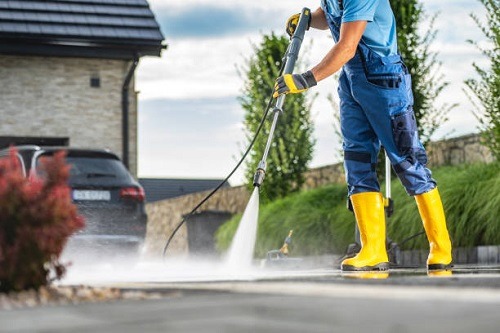
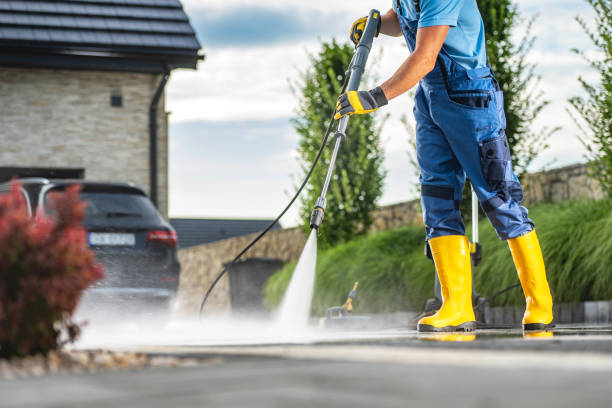
Pressure washing uses a high-pressure stream of water to blast dirt, mold, mildew, and grime off hard surfaces such as driveways, sidewalks, patios, and parking lots. Power washing business uses the same kind of pressure but adds heated water, which helps with grease and sticky residue. Soft washing uses low pressure with a cleaning solution, and it’s the safer choice for roofs, siding, and other delicate surfaces.
The difference matters for your business. High pressure on the wrong surface can strip paint, gouge wood, or force water behind siding. Many successful operators combine pressure washing for concrete with soft washing for houses and roofs.
Is a Pressure Washing Business Profitable? Start a Pressure Washing Business
It can be, because the main cost of a job is your time, not materials. Shopify’s article, citing a Thimble survey, reports that the average pressure washing owner brings in around $50,000 in annual gross revenue, with some reporting far more. That figure is a gross average, not profit, and results vary widely by market and effort.
Bean count’s 2026 guide describes pressure washing as a low-capital service business with repeat local customers, and notes that tracking your cost per job helps you see whether a $150 driveway job really earned $90 or just $45 after chemicals, fuel, and time.
Sample Income Scenarios (Planning Examples Only): Start a Pressure Washing Business
| Scenario | Jobs per week | Average price | Weekly gross | Monthly gross |
|---|---|---|---|---|
| Part-time (weekends and evenings) | 4 | $220 | $880 | about $3,500 |
| Full-time in season | 10 | $250 | $2,500 | about $10,000 |
These are gross numbers before fuel, chemicals, insurance, equipment repairs, and taxes. Work also slows in cold weather, so don’t assume every month looks the same. Treat these as planning examples, not guarantees.
How Much Does It Cost to Start a Pressure Washing Business?
Estimates vary, because they depend on whether you already own a truck and how much equipment you buy.
- Very lean: Durable’s 2026 guide says you can start for under $1,000 with a basic gas pressure washer and simple setup.
- Starter rig: Bean count’s 2026 guide describes a roughly $1,500 starter rig.
- Typical total: Jobber, as cited by Shopify, puts total startup at about $2,000 to $5,000, while Bean count’s overall range is $2,000 to $10,000.
- Business basics: Bean count lists licensing, insurance, EIN, and banking at about $300 to $800.
Equipment Checklist and Cost Notes: Start a Pressure Washing Business
| Item | Notes |
|---|---|
| Gas pressure washer | Durable suggests a unit with about 2.5 to 3.5 GPM and 2,500 to 3,000 PSI, roughly $400 to $600 for an entry model; commercial-grade units can cost $760 to $2,000 or more |
| Surface cleaner attachment | Speeds up driveways and flatwork and gives even results |
| Hoses, nozzles, and extension wand | Several lengths and tip sizes for different surfaces |
| Cleaning chemicals | Detergents and degreasers, bought in bulk to lower cost |
| Soft-wash system | A separate, later investment for roofs and siding |
| Safety gear | Eye protection, gloves, boots, and full-coverage clothing |
| Containment gear | Mats, berms, or a wet/dry vacuum for sensitive areas |
| Vehicle or trailer | Assumed to be something you already own |
Ways to Keep Costs Down: Start a Pressure Washing Business
- Start with one good machine instead of a full setup.
- Skip soft washing and roof work at first. It needs separate equipment and training.
- Buy chemicals in bulk once you know what you use most.
- Use free tools first: a free Google Business Profile and neighborhood groups beat paid ads at launch, according to Beancount.
- Add equipment from profits, not from credit.
Do You Need a License or Certification? Start a Pressure Washing Business
Certification isn’t legally required, but training can build trust. Shopify’s article mentions programs such as Power Washers of North America and Power Wash Academy.
What you usually do need:
- A business license from your city or county
- A DBA or LLC, depending on how you want to structure the business (see our guide on whether you need an LLC for a small business)
- A free EIN from the IRS
- A business bank account
- Sales tax registration if your state taxes cleaning services
StartupOwl also lists an environmental or wastewater permit in jurisdictions that regulate stormwater runoff under EPA NPDES rules, and Durable notes that permits may apply when you wash large commercial properties. Check with your city.
What About Wastewater and Storm water Rules?
This is the part most beginners skip, and it’s where fines come from. Pressure washing creates dirty runoff full of soap, grease, and debris, and in most places that water isn’t allowed to flow into storm drains, which carry water untreated to local waterways.
Local examples show how seriously cities treat this. Escondido, California, requires mobile washing businesses to contain and recover wash water, and Rancho Santa Margarita says it’s unlawful for wash water from mobile detailers to enter storm drains. The same principles apply to pressure washing.
Practical ways to stay compliant:
- Look up your city’s stormwater rules before you start.
- Block nearby storm drain inlets with covers or barriers before washing.
- Collect runoff with a mat, berm, or wet/dry vacuum when working near drains or on commercial lots.
- Dispose of wash water properly, for example into a sanitary sewer connection where allowed, not a gutter.
- Use less hazardous cleaners and follow the product label.
- Wash over landscaping carefully, and avoid strong chemicals near plants and pets.
For more on how these rules affect mobile cleaning businesses, see our guide on the mobile car detailing business in the USA.
What Insurance Does a Pressure Washing Business Need?
High-pressure water can break windows, damage siding, strip paint, and injure people. Bean count calls liability insurance non-negotiable for exactly that reason.
- General liability: Startup Owl says it averages about $500 to $1,500 per year for $1 million in coverage, and Durable lists $500 to $1,200 per year. Some insurers, including Thimble and NEXT Insurance, offer pressure washing policies online.
- Inland marine or equipment coverage: For your machines and tools.
- Commercial auto insurance: If you use your vehicle for the business.
- Workers’ compensation: Once you hire help.
Read our guides on small business liability insurance in the USA and home-based business liability insurance. If a property manager or commercial client asks for proof, see how to get a certificate of insurance.
How Much Should You Charge? Start a Pressure Washing Business
Pricing depends on surface type, size, condition, and your market. Common 2026 benchmarks:
- Per square foot: Durable suggests about $0.15 to $0.40, Startup Owl says $0.20 to $0.50, and Bean count lists commercial flatwork at about $0.10 to $0.35.
- Per hour: Startup Owl lists $50 to $150 per hour.
- Minimum trip charge: Durable suggests $150 to $250.
- Consumer price ranges: Shopify’s article, citing HomeAdvisor and Angi, mentions about $100 to $500 for deck, fence, window, and driveway washing, and $150 to $1,250 for house washing.
Simple pricing formula:
(Square feet × your rate per square foot) + chemicals + fuel + travel, with a minimum trip fee
Example: An 800-square-foot driveway at $0.30 per square foot is $240, which is above a $150 minimum. A small walkway of 150 square feet at $0.30 is only $45, so the minimum trip fee protects you.
Pricing tips:
- Charge by square foot for flat surfaces and by the job for houses.
- Add a surcharge for heavy staining, mold, rust, or hard-to-reach areas.
- Track cost per job for your first 20 jobs, as Bean count suggests, to learn your real profit.
- Don’t compete only on price. Before-and-after photos and reviews justify higher rates.
Before you finalize prices, check your local competition with the free market research tools for startups we reviewed.
What Services Can You Offer?
Core services:
- Driveways, sidewalks, and patios
- Decks and fences
- Garage floors and entryways
Higher-value services (often need training or extra gear):
- House washing with soft wash
- Roof cleaning
- Commercial storefronts and parking lots
- Fleet and truck washing
Add-ons and off-season services:
- Gutter cleaning
- Window cleaning
- Sealing for decks and concrete
- Holiday light installation in cold months
Bean-count notes demand peaks in spring and fall, and winter is slow in cold climates unless you add services like soft washing, gutters, or holiday lights.
How Do You Get Your First Customers?
Pressure washing is hyperlocal and highly visual, so low-cost tactics work well.
- Create a free Google Business Profile with photos and your service area.
- Post before-and-after photos on Facebook, Instagram, and Tik-Tok.
- Use the “5-around” door hanger strategy. Durable suggests leaving flyers at neighboring houses after each job to generate referrals.
- Join Next door and neighborhood Facebook groups.
- Offer to clean your own driveway or a friend’s to build your portfolio.
- Partner with realtors, property managers, and HOAs.
- Approach local businesses with dirty entrances and parking lots.
- Ask every happy customer for a review and a referral.
Step-by-Step: How to Start a Pressure Washing Business
- Pick your starting niche. Residential flatwork is the easiest entry point.
- Check local rules. Call your city about licensing and wastewater.
- Register your business. DBA or LLC, EIN, and a business bank account.
- Buy insurance. General liability before your first paid job.
- Buy your starter equipment. One reliable machine, a surface cleaner, hoses, and safety gear.
- Practice on your own property and friends’ homes.
- Take before-and-after photos for your online profiles.
- Set prices and a minimum fee.
- Launch your Google Business Profile and local marketing.
- Track every job’s profit and adjust your prices.
How Do You Avoid Damaging Property and Staying Safe?
- Test a small hidden area first. Too much pressure can strip paint or gouge wood.
- Match the pressure to the surface. Use soft washing for siding and roofs.
- Protect windows, outlets, plants, and pets before you start.
- Photograph existing damage before you begin, and use a written estimate or agreement.
- Wear protective gear. High-pressure water can cause serious injuries.
- Never mix cleaning chemicals, and read labels carefully.
- Watch for slippery surfaces and ladders.
- Keep customers and children away from the work area.
What About Taxes?
As a sole proprietor you’ll owe income tax plus self-employment tax on net profit, and you may need to make quarterly estimated payments. Keep receipts for equipment, chemicals, fuel, insurance, and vehicle use. If you ever overpay or need to correct a return, our tax refund process guide explains the steps.
How Fast Can You Earn Back Your Startup Costs?
Here’s a planning example, not a guarantee. Say you spend about $2,300: a $1,500 starter rig plus about $800 for licensing, insurance, and basics. If your average job is $230 and you keep about 70% after chemicals and fuel, each job nets roughly $160. That means about 14 jobs to recover your costs. With four jobs a week, that’s about a month, depending on your area and how quickly you find customers.
Common Mistakes to Avoid:
- Skipping insurance. One cracked window can cost more than a year of premiums.
- Ignoring wastewater rules. Fines are costly.
- Using too much pressure on delicate surfaces.
- Underpricing and forgetting the minimum trip fee.
- Buying expensive equipment too early.
- Taking on roofs or houses without training.
- Not photographing before starting.
- Relying on summer income only.
- Mixing personal and business money.
Final Thoughts:
Learning how to start a pressure washing business really comes down to a few decisions: start with one solid machine, get insured, learn your local wastewater rules, price by square foot with a minimum fee, and let before-and-after photos market your work. It’s physically demanding, and it’s seasonal in many places, but it rewards reliability and repeat local customers.
Start small, protect yourself, and track your profit on every job. A few good driveways can turn into a steady neighborhood business.
Take Action Today:
Take three steps this week. Call your city to ask about licensing and wastewater rules, request quotes for general liability insurance, and price a starter pressure washer and surface cleaner. Then clean your own driveway and photograph it for your Google Business Profile. Save this guide so you can follow the steps as you build.
Experience and Expertise:
Why you can trust this guide: I’ve been writing about business and personal finance for three years, and this site focuses on practical small business ideas you can start on a small budget. I build these guides from current cost data, insurance and pricing resources, and local government rules, and I flag where numbers change by city and state. This guide is for general education and is not legal, tax, or financial advice.
Sources and Further Reading:
- Durable, How to Start a Pressure Washing Business: https://durable.com/guides/how-to-start-a-pressure-washing-business
- Bean count, How to Start a Pressure Washing Business in 2026: https://beancount.io/blog/2026/08/13/how-to-start-pressure-washing-business-2026-costs-guide
- Startup Owl, How to Start a Pressure Washing Business: https://startupowl.com/start/how-to-start-a-pressure-washing-business
- Shopify, How To Start a Pressure Washing Business in 10 Steps: https://www.shopify.com/pk/blog/how-to-start-a-pressure-washing-business
- City of Escondido, Mobile Vehicle Washing: https://www.escondido.gov/DocumentCenter/View/4150
- City of Rancho Santa Margarita, Best Management Practices for Mobile Detailers: https://www.cityofrsm.org/DocumentCenter/View/438/Mobile-Detailers-PDF
- U.S. EPA, Clean Water Act and NPDES: https://www.epa.gov/npdes
- IRS, Self-Employed Individuals Tax Center: https://www.irs.gov/businesses/small-businesses-self-employed/self-employed-individuals-tax-center
- Your own city’s storm water program and business license office
Transparency Note:
This article is for general information only. I have no financial relationship with any equipment brand, insurer, or service mentioned.
How this guide was prepared:
This guide is based on 2026 startup guides, insurance and pricing resources, and storm water rules. Costs, permits, and wastewater regulations vary by state and city, so confirm local requirements before you start. This article is for general education and is not legal, tax, or financial advice.
Frequently Asked Questions:
How much does it cost to start a pressure washing business?
A very lean start can be under $1,000, a starter rig is around $1,500, and typical total startup costs range from about $2,000 to $10,000 depending on your equipment and vehicle.
Do I need a license to start a pressure washing business?
Usually a business license, though rules vary by city and state. Certification isn’t legally required, but some owners get trained to build trust.
How much should I charge for pressure washing?
Common ranges are about $0.15 to $0.50 per square foot or $50 to $150 per hour, with a minimum trip charge of about $150 to $250.
Do I need insurance?
It isn’t always legally required, but it’s strongly recommended. General liability typically runs about $500 to $1,500 per year.
Can I pressure wash and send the water into the street?
In many places, no. Wash water generally can’t enter storm drains, and some cities require containment and recovery.
What’s the difference between pressure washing and soft washing?
Pressure washing uses high pressure for hard surfaces like concrete. Soft washing uses low pressure with cleaning solutions for roofs and siding.
Is pressure washing seasonal?
In many areas, yes. Demand peaks in spring and fall, so add services like gutter cleaning or holiday lights for winter.
Should I start with a truck or a trailer?
Use a vehicle you already own to start. Add a trailer or truck setup once the business is earning.

Author is the founder and lead writer at SmartWebCreator.org, a resource dedicated to helping aspiring entrepreneurs launch profitable small businesses on a budget of $1,000 or less. With a focus on practical, research-backed guidance, Naeem Iqbal researches real-world startup costs, regulatory requirements, and growth strategies across dozens of low-investment business models — from food service to home-based ventures.
Every guide on SmartWebCreator.org is written to help beginners avoid costly mistakes, understand legal requirements, and build a realistic path from idea to income — without needing a large upfront investment.
📧 Contact: webcreator2474@gmail.com
🌐 Website: smartwebcreator.org