
Do I Need an LLC for a Small Business? A Clear Guide for U.S. Owners
You’ve got a business idea, maybe a few customers, and plenty of advice. One friend says, “Form an LLC before you sell anything.” Another says it’s a waste of money. So, do I need an LLC for a small business, or can you skip it for now?
Here’s the short answer. No, U.S. law doesn’t require you to form an LLC to run a small business. But for many owners, it’s still a smart move, because it can protect your personal savings and make your business look more professional. Whether it’s right for you depends on your risk level, your income, your state’s fees, and where you want the business to go.
This guide breaks the decision down in plain English, so you can choose based on facts instead of pressure.
The Quick Answer: LLC for a Small Business
| Your situation | Do you need an LLC? |
|---|---|
| Testing an idea with little income and low risk | Probably not yet |
| Selling products or services to the public | Strongly consider it |
| Hiring help, meeting clients, or doing physical work | Likely yes |
| Starting with a partner | Yes, with a written operating agreement |
| Earning steady profit and wanting tax flexibility | Worth a talk with a CPA |
| A lease, license, or client contract requires it | Yes |
What Is an LLC? LLC for a Small Business
A limited liability company (LLC) is a business structure created under state law. Its biggest benefit is personal liability protection. In general, it separates your personal assets, such as your home, car, and savings, from the debts and lawsuits of the business.
It also keeps taxes simple. By default, LLC profits “pass through” to the owners’ personal tax returns, so the LLC itself usually doesn’t pay a separate federal income tax. Think of it as a legal wall between you and your business. The wall isn’t unbreakable, but it’s a real layer of protection.
What Happens If You Don’t Form an LLC?
If you start selling without registering any structure, the law treats you as one of two things:
- A sole proprietorship, if you’re the only owner
- A general partnership, if you share the business with someone
Both happen automatically, and both are free. The catch is that there’s no legal separation between you and the business. If the business owes money or is sued, your personal assets can be at risk.
Many sole proprietors use a different business name and register a DBA (“doing business as”) with the state or county. A DBA is only a name registration. It does not give you liability protection, which is the most common misunderstanding about it.
The Real Benefits of an LLC: LLC for a Small Business
1. Personal liability protection. If the business can’t pay a vendor or is sued, your personal assets are generally shielded, as long as you keep the LLC properly separate from your personal life.
2. Credibility. “Harper Design LLC” looks more established than a personal name. That can help with banks, landlords, vendors, and bigger clients.
3. Flexible taxation. A single-member LLC is taxed like a sole proprietorship by default, and a multi-member LLC is taxed like a partnership. Later, you can elect S corporation treatment if it makes financial sense. This is called pass-through taxation with room to adjust.
4. Cleaner finances. Forming an LLC encourages you to open a separate business bank account and track every dollar, which makes bookkeeping and tax time far easier.
5. Room to grow. An LLC can add members, take on partners, and bring in investors more smoothly than a bare sole proprietorship.
What an LLC Does Not Do: LLC for a Small Business
This is where many articles oversell. An LLC helps, but it isn’t a force field.
- It doesn’t replace insurance. It can’t shield you from every claim, so it works best alongside liability coverage. See our guide on small business liability insurance in the USA for the options.
- It doesn’t protect you from your own negligence. If you personally cause harm, you can still be held responsible.
- It doesn’t cover personal guarantees. If you sign a loan or lease in your own name, you’re still on the hook.
- It doesn’t automatically cut your taxes. A default LLC is taxed like a sole proprietorship. Savings usually come from an S corporation election later, not from the LLC itself.
- It can lose its protection if you mix funds. Courts can disregard the LLC if you treat it like a personal wallet, a concept known as “piercing the corporate veil.”
How Much Does an LLC Cost? LLC for a Small Business
Cost depends heavily on your state, so always check your own state’s fee page. Based on 2026 data, state filing fees run roughly $35 to $500, annual report fees run $0 to $500 per year, and a few states add franchise taxes of $800 or more. One 2026 estimate puts the average first-year cost across states at around $224, combining the filing fee and a typical annual report fee.
Real examples show how different it can be:
- California: a $70 filing fee, plus an $800 minimum annual franchise tax that applies even if the LLC earns nothing.
- Massachusetts: about $500 to file and about $500 per year after.
- Texas: a $300 filing fee, with no flat annual report fee for most small businesses.
- Some states charge only $40 to $50 to file.
Other costs to plan for:
- Registered agent: required in every state. A paid service typically costs about $100 to $200 per year.
- Publication requirements: a few states, such as New York and Nebraska, require you to publish a formation notice in local newspapers.
- Local licenses and permits.
- Operating agreement: free if you write it yourself, or paid if a lawyer drafts it.
- EIN: free directly from the IRS.
Always add up your first-year total, not just the filing fee. And as a general rule, form your LLC in the state where you live and work. Forming in a different state while operating in yours can mean paying fees in both.
LLC Taxes and the S Corporation Election: LLC for a Small Business
Tax is often the deciding factor, so here’s the simple version.
Default treatment. A single-member LLC reports profit on Schedule C of your personal return. You pay income tax plus self-employment tax (Social Security and Medicare) on net earnings.
S corporation election. As profit grows, some owners file IRS Form 2553 to be taxed as an S corporation. This can reduce self-employment tax, because you pay yourself a reasonable salary and take the rest as distributions. But it adds payroll, extra filings, and costs, so it usually pays off only once profit reaches a meaningful level. That’s the moment to talk with a CPA.
A useful rule: don’t form an LLC only to save taxes at the start. Form it for protection and credibility, then revisit your tax setup as you grow.
When You Probably Need an LLC: LLC for a Small Business
Consider forming one if any of these fit:
- Customers could be injured or lose money because of your product or service
- You rent space, own property, or hold meaningful assets
- You have employees, contractors, or partners
- You do physical, higher-risk work such as repairs, construction, food, fitness, or childcare
- A landlord, client, or license requires a formal entity
- You earn steady profit and want tax planning options
- You want to keep personal and business money clearly separate
When You May Not Need One Yet:
An LLC may be premature if:
- You’re testing an idea and earning little or nothing
- Your risk is very low, such as freelance writing or consulting with no physical exposure
- Your state’s yearly costs are high and your income can’t justify them yet
- You’re not ready to keep business finances separate
Even then, don’t go unprotected. Liability insurance and clear written contracts can cover many early-stage risks, and you can form the LLC later. Just remember that an LLC formed today doesn’t protect you from problems that already happened.
LLC vs. Sole Proprietorship vs. Corporation:
| Feature | Sole Proprietorship | LLC | Corporation (C or S) |
|---|---|---|---|
| Formation | Automatic | File with state | File with state, more formalities |
| Liability protection | None | Generally yes | Generally yes |
| Startup cost | Very low | Low to moderate | Moderate to high |
| Taxes | Personal return | Pass-through by default | Corporate or pass-through (S corp) |
| Paperwork | Minimal | Moderate | Heavy (meetings, bylaws) |
| Best for | Testing ideas, low risk | Most small businesses | Larger firms, investors |
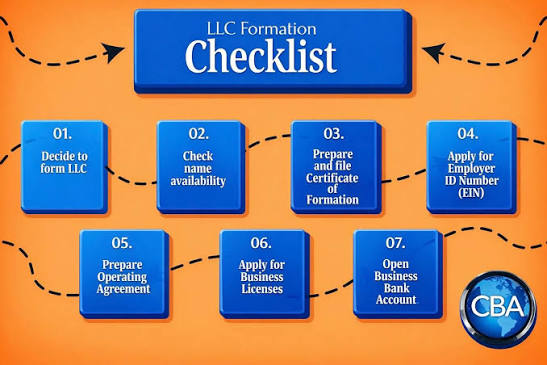
How to Form an LLC: Step by Step
- Choose your state. Usually the one where you live and operate.
- Pick a name. It must be unique in your state and normally include “LLC.”
- Appoint a registered agent. This can be you, someone with a physical address in the state, or a paid service.
- File Articles of Organization with your state’s business office and pay the fee.
- Write an operating agreement. It sets out ownership, roles, and rules. Even single-member LLCs benefit from one.
- Get an EIN for free on IRS.gov.
- Open a business bank account and keep personal money out of it.
- Get licenses, permits, and insurance required at the federal, state, and local levels.
- Stay compliant. File annual reports and pay any franchise taxes on time.
A note on federal reporting: beneficial ownership information (BOI) reporting to FinCEN has changed several times. In 2025, the rules were revised so that U.S.-formed companies were exempted. Because this area has shifted repeatedly, check FinCEN’s website for the current status before relying on any article, including this one.
Common Mistakes to Avoid:
- Mixing personal and business money. It can weaken your protection.
- Skipping the operating agreement. It prevents disputes, especially with partners.
- Missing annual reports and fees. Late filings can bring penalties or loss of good standing.
- Assuming an LLC replaces insurance. It doesn’t.
- Forming in the wrong state. Out-of-state formation often adds cost without benefit.
- Ignoring taxes. Ask a CPA about estimated payments and S corporation timing.
- Waiting until something goes wrong. Protection only helps going forward.
Final Thoughts:
So, do I need an LLC for a small business? Not by law, but for most businesses with real customers, real money, or real risk, it’s a smart layer of protection. If you’re only testing an idea, you can start simple and form one when the stakes rise. Either way, pair your structure with good insurance, clean bookkeeping, and honest advice from a CPA or attorney.
The best choice is the one you make deliberately, with your own state’s numbers in front of you.
Take Action Today:
Don’t guess. Check your numbers. Visit your state’s business filing website and look up the LLC filing fee and annual fee. Then list your three biggest business risks and ask a CPA or attorney whether an LLC fits. Save this guide so you can follow the steps when you’re ready to form.
Experience, Expertise “How This Article Was Researched”
How this guide was researched: I reviewed current 2026 state LLC fee data, California’s official franchise tax rules as summarized by the Franchise Tax Board, IRS guidance on LLC taxation and Form 2553, and general U.S. Small Business Administration guidance on business structures. I focused on plain-English explanations and flagged every place where rules vary by state. Fees and rules change often, so confirm details with your state before filing.
Why you can trust this guide: I’ve spent three years writing about business, personal finance, and self-improvement, and I focus on turning complicated money and legal topics into clear, practical steps. This article is for general education and is not legal, tax, or financial advice.
Sources and further reading:
- U.S. Small Business Administration, business structure guidance: https://www.sba.gov
- IRS, Limited Liability Company information and Form 2553: https://www.irs.gov
- IRS, Apply for an Employer Identification Number: https://www.irs.gov
- FinCEN, beneficial ownership information: https://www.fincen.gov
- California Franchise Tax Board, LLC filing information: https://www.ftb.ca.gov
- Your own state’s Secretary of State or business filing website
Transparency note:
Transparency: This article is for general information only. I have no financial relationship with any service mentioned.
Frequently Asked Questions:
Is an LLC legally required to run a small business?
No. You can operate as a sole proprietor or general partnership without forming one, though you may still need local licenses and permits.
Do freelancers need an LLC?
Not always. Many freelancers start as sole proprietors and form an LLC as income and risk grow, especially if clients ask for it.
Does an LLC protect my personal assets?
Generally yes, for business debts and claims, if you keep finances separate and follow your state’s rules. It doesn’t cover your own negligence or debts you personally guaranteed.
Is an LLC worth it for a side hustle?
It depends on the risk and your state’s cost. A low-risk side hustle can often start without one, while a higher-risk one benefits from the protection.
How much does an LLC cost per year?
It varies by state, from nothing in some states to $800 or more in places like California. Add registered agent fees if you use a service.
Can I form an LLC myself?
Yes. You can file directly with your state, or pay a formation service for convenience.
Can I switch from a sole proprietorship to an LLC later?
Yes, many owners do. Just update your bank accounts, licenses, and contracts afterward.

Author is the founder and lead writer at SmartWebCreator.org, a resource dedicated to helping aspiring entrepreneurs launch profitable small businesses on a budget of $1,000 or less. With a focus on practical, research-backed guidance, Naeem Iqbal researches real-world startup costs, regulatory requirements, and growth strategies across dozens of low-investment business models — from food service to home-based ventures.
Every guide on SmartWebCreator.org is written to help beginners avoid costly mistakes, understand legal requirements, and build a realistic path from idea to income — without needing a large upfront investment.
📧 Contact: webcreator2474@gmail.com
🌐 Website: smartwebcreator.org



Pingback: free market research tools
Pingback: home based business liability insurance
Pingback: certificate of deposit FDIC insured
Pingback: lawn care business under $1,000
Pingback: a cleaning business from home
Pingback: mobile car detailing business
Pingback: start a pressure washing business
Pingback: virtual assistant jobs with no experience
Pingback: : LLC vs sole proprietorship